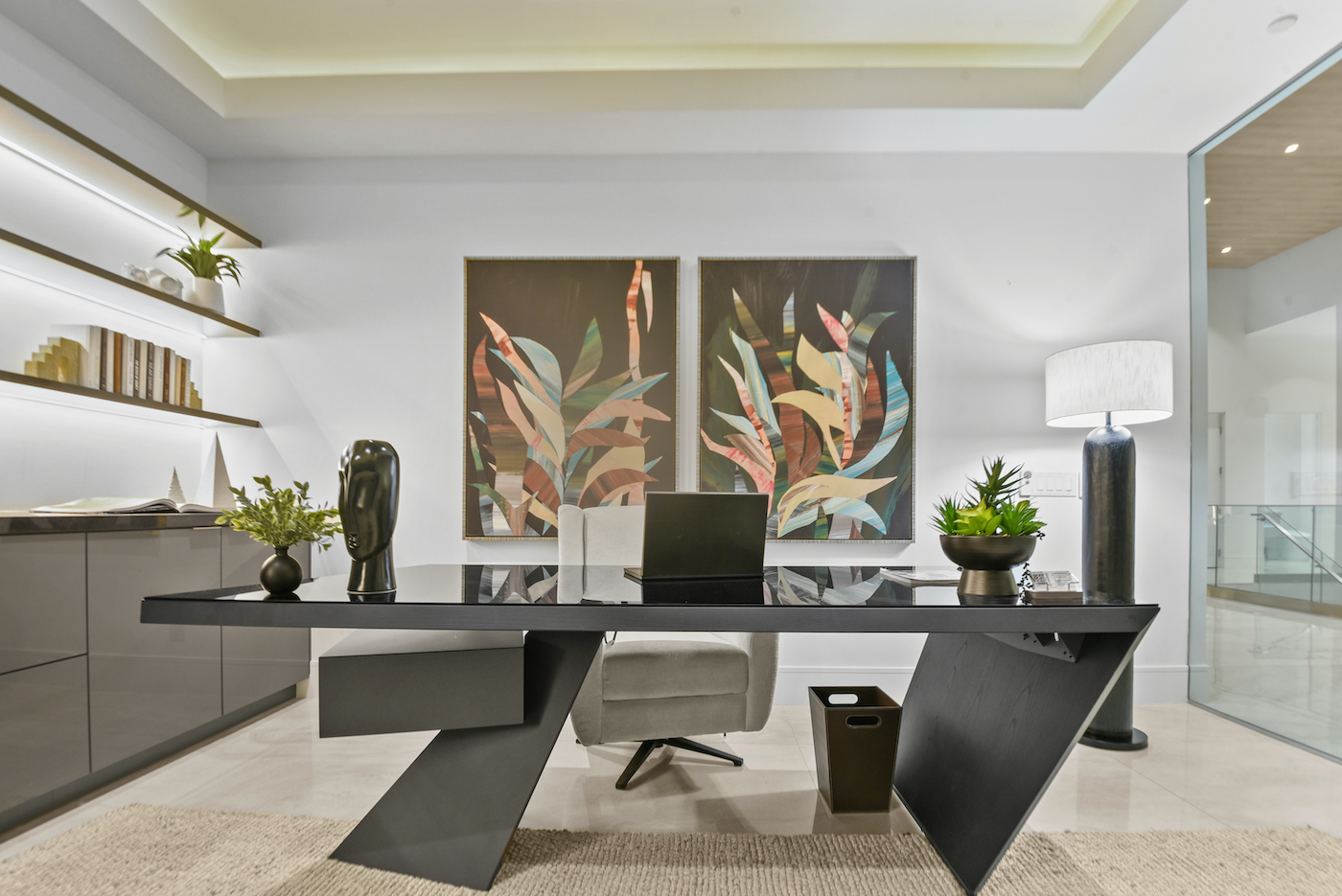

There is a moment in almost every home transformation show when everything comes together.
The furniture is in. The pillows are perfectly placed. The cameras move through the finished rooms. Then comes the reveal.
After working behind the scenes on 12 episodes of HGTV productions in Las Vegas, we’ve learned something interesting:
What you see on television is real.
But it isn’t the whole story.
Utopia Home Staging has worked on Flip the Strip, starring the men of Australia’s Thunder From Down Under; The House My Talent Bought, from the House Hunters family; and Ugliest House in America and Sin City Rehab, both featuring designer and HGTV personality Alison Victoria.
Different shows. Different houses. Very different productions.
Along the way, we’ve staged for television cameras, worked around production schedules, watched rooms transform through a monitor, and learned just how different preparing a home for television can be from staging one to sell.
And there are a few things viewers might be surprised to know.
First, HGTV Gets Something Very Right
A room can change the way you feel about a house.
That isn’t television magic.
We’ve watched it happen on set, and we watch it happen every week in homes we’re preparing for the Las Vegas real estate market.
Furniture establishes scale. Art moves the eye. A rug can make an oversized room finally make sense. The right placement can turn an awkward pass-through into a purposeful space. And sometimes moving one chair six inches really does change an entire camera angle.
Those details matter because people don’t experience real estate as a collection of dimensions.
They experience it visually and emotionally.
The National Association of Realtors’ 2025 Profile of Home Staging found that 83% of buyers’ agents said staging made it easier for buyers to visualize a property as their future home.
That may be the biggest thing television has taught the public about staging: seeing the possibility changes the experience.
But what happens outside that beautifully finished camera frame is where television and real estate begin to look very different.
What You Don’t See Just Outside the Camera Frame
Here’s something we didn’t fully appreciate until we worked on television:
When you see the finished house on screen, the house itself may be nowhere near finished.
The camera sees what it needs to see.
Just outside that frame, there can be controlled chaos.
Trades may still be working. Tools and construction materials are being shifted from one room to another. Something may still need paint. Plumbing may not yet be connected. A fixture that appears finished for the reveal may be temporarily installed or staged as a prop so production can get the shot and keep moving.
Then the camera moves, and everyone gets back to work.
It isn’t trickery. It’s television production.
These shows operate on extraordinarily tight schedules, with renovation, design, staging and filming all moving toward the same deadline. The production team has to make a particular camera frame ready even when the rest of the house is still catching up.
After 12 episodes, we’ve become very familiar with the distinction between camera-ready and move-in ready.
And honestly, that’s part of what makes being behind the scenes so interesting.
The viewer sees a serene, beautifully finished room.
We remember what was happening six feet outside the shot.

The Economics Behind the Reveal Are Different, Too
There is another part of television staging viewers rarely see: the businesses behind the transformation.
Professional staging companies are still businesses, and participation in a television production doesn’t mean the staging itself is simply donated. But television has an ecosystem that doesn’t exist in a traditional real estate transaction.
Manufacturers, local businesses and brands may provide products or participate in partnerships for the opportunity to have their work showcased to a national audience. Designers, trades, suppliers and staging companies balance the potential value of that exposure against the additional demands of television production.
And those demands can be significant.
A television schedule is ultimately a production schedule. Construction, filming, styling and staging are all competing to reach the same reveal, sometimes within an extraordinarily compressed window.
From the staging side, that can mean the installation window you planned for becomes much smaller because construction is still being completed. Crews may be working around one another late into the day. Furniture and accessories may be entering a property that is still functioning as an active jobsite.
None of that makes television bad.
It simply means participating in a production requires a business to decide whether the exposure and experience justify the demands being placed on its team, inventory and schedule.
After 12 episodes, we’ve had enough experience to make that decision for ourselves.
Why We’re Bringing the Lessons Home
We originally participated in television for reasons that went well beyond seeing our name on screen.
Home staging was still widely misunderstood in our local market. HGTV had an enormous platform for showing buyers, sellers and real estate professionals something we believed deeply:
Presentation can change the way people perceive a property.
We wanted to be part of that conversation.
And we’re glad we were.
Working on 12 episodes gave our team a fascinating education in camera angles, visual storytelling, buyer psychology and the extraordinary influence television has had on what consumers expect a home to look and feel like.
It also helped us understand where our time creates the most value.
Today, we’re choosing to bring those lessons back to the work we do every day rather than pursue additional television productions.
That’s a deliberate business decision.
Producing television and preparing a luxury property for market are two very different disciplines. Television understandably prioritizes the production. Our business has to prioritize the property, our inventory, our design standards, our team and, most importantly, the sellers and Realtor partners who trusted us with their listing.
As Utopia has grown further into the luxury market, protecting those standards has become increasingly important to us.
A television production can require enormous flexibility from participating businesses.
A luxury listing requires something different from us: planning, precision, carefully selected inventory, proper installation time and the ability to give the property the attention it deserves.
We don’t want one to compromise the other.
So for us, 12 episodes feels like a wonderful chapter rather than something we’re trying to turn into the next one.
But there is one part of the television experience that absolutely continues to influence our work.
HGTV changed the buyer.
HGTV Has Changed What Buyers Expect
Years of home transformation programming have exposed consumers to professionally designed, renovated and styled spaces at a scale that simply didn’t exist a generation ago.
Whether they realize it or not, that exposure has changed their visual expectations.
The National Association of Realtors’ 2025 staging research puts numbers behind it.
Nearly half of real estate professionals surveyed — 48% — said buyers expect homes to look like properties staged for television.
Even more interesting, 58% reported buyers being disappointed when the homes they toured didn’t live up to what they had seen on television.
And 77% said television programs created increased or unrealistic expectations about homes.
Think about what that means for a seller.
A buyer may be walking into an ordinary resale property while subconsciously comparing it with years of professionally designed, renovated, styled and produced spaces.
We can’t change that expectation.
But we can understand it.
Professional home staging isn’t about turning every Las Vegas listing into an HGTV set. It’s about recognizing the visual standard buyers have become accustomed to and presenting a property competitively within its own market.
We may have decided that participating in additional television productions isn’t where Utopia should focus its resources.
But the buyer walking into your listing has still been influenced by them.
And understanding that buyer is part of our job.

The Camera Is Always Part of the Design
One lesson from television has become even more relevant as real estate marketing has evolved.
You become incredibly aware of what the camera sees.
Something can look wonderful while you’re standing in the middle of a room and completely wrong through the lens.
A chair can interrupt a sightline. An accessory can suddenly become distracting. Furniture that technically fits can visually crowd the frame. Something beautiful may be completely lost from the angle where the camera actually needs to be.
Today, the first tour of a property often happens through a screen.
Before buyers experience the ceiling height, the view or the way the rooms connect in person, they’re swiping through listing photography.
That’s why our designers don’t only ask:
How does this room feel in person?
We also ask:
What is the buyer going to see through the camera?
We think about the doorway. The sightline into the next room. The view through the windows. What the camera will capture from the angle the photographer is likely to use.
But there is one very important difference.
On television, the camera can define the frame.
In real estate, eventually the buyer opens the front door.
That’s where trust becomes important.
The photography should create enough emotion and interest to earn the showing. But when buyers arrive, the actual property has to deliver on the promise those photographs made.
The first tour happens online. The emotional connection has to continue in person.
Television Has a Reveal. Real Estate Has a Launch.
That distinction may summarize our 12 episodes better than anything else.
Television is working toward the reveal.
We’re working toward the launch.
The strongest sequence is:
Prepare → Stage → Photograph → List
There are no retakes once a listing hits the market.
There is no production team deciding which corner buyers will see.
And there is no one standing beside the buyer explaining what the house could become.
The property has to communicate that for itself.
That’s why we think about camera angles when we stage real estate — but we don’t stage only for the camera.
The photography creates the desire to visit.
The actual experience validates it.
Television taught us to pay extraordinary attention to what happens inside the frame.
Real estate has taught us that what happens after the buyer steps through it matters even more.
Every House Still Needs Its Own Story
Here’s another lesson television reinforced for us:
Every house needs its own point of view.
Television would get boring pretty quickly if every reveal looked exactly the same.
Real estate staging should work the same way.
There isn’t one “staging look” that belongs in every property.
A contemporary estate in The Ridges shouldn’t feel like a family home in Henderson. A Spanish-style property shouldn’t lose the character that makes it memorable because contemporary neutrals happen to be popular.
And a $600,000 home shouldn’t simply receive a scaled-down version of the design that belongs in an $8 million estate.
The architecture tells us something.
The neighborhood tells us something.
The price point tells us something.
The likely buyer tells us something.
Our job is to listen to all four.
That’s the difference between putting attractive furniture into a house and actually positioning a property for sale.
The Best Reveal We’ve Had Wasn’t on Television
One of our staged properties on City View Ridge came to market at approximately $8.1 million.
There were no production cameras waiting for the reaction.
No director.
No retakes.
No dramatic music.
The property sold in three days at 99.4% of list price.
That’s a very different kind of reveal.
The staging wasn’t designed to create the most dramatic before-and-after photograph possible. It was designed for that architecture, that price point, that competitive inventory and the buyer we expected to walk through the door.
Furniture scale mattered.
Sightlines mattered.
Photography mattered.
The experience of walking into the property mattered.
For us, that’s the distinction between staging for entertainment and staging for real estate.
Television needs viewers to keep watching.
A listing needs buyers to stop scrolling.
Then the house has to give them a reason to stay.
What 12 Episodes Taught Us
Working on HGTV didn’t teach us that real estate staging should look more like television.
It taught us to pay even closer attention to how people see a space.
Through a doorway.
Through a photograph.
Through a camera.
And ultimately through the eyes of the person deciding whether this could become home.
It also gave us an appreciation for what goes into those television transformations: the tight schedules, the creativity, the problem-solving, the businesses and brands involved, the crews working just outside the shot, and the ability to create something beautiful even when there is still plenty of chaos behind the camera.
But perhaps the most valuable lesson came after the cameras were gone.
It helped us understand where we want to put our energy.
The latest national research supports the relationship between staging and buyer perception. NAR’s 2025 report found that 49% of sellers’ agents observed that staging reduced time on market, while 29% of agents reported that staging was associated with a 1% to 10% increase in the dollar value offered.
Our own Las Vegas results have been even more compelling. Across Utopia Home Staging’s internal sales analysis, our staged properties have sold approximately 33 days faster than the broader Las Vegas market baseline and received offers approximately 4% higher.
Of course, no staging company can promise a particular sale price or timeline. Pricing, condition, location, inventory and market conditions all matter.
But after staging homes for both television cameras and actual buyers, one principle has remained remarkably consistent:
The room has to make someone want to see what happens next.
For television, that’s the next scene.
For real estate, it’s the showing.
That’s where we’ve chosen to focus.
Not on creating another television credit, but on taking everything we’ve learned about cameras, visual storytelling and buyer expectations and putting it to work for the Realtor partners and sellers who trust us with their listings.

HGTV Home Staging: Frequently Asked Questions
Is HGTV home staging realistic?
The transformation is real. What television can’t show in real time is everything required to create it.
Planning, sourcing, construction, coordination, installation and adjustments happen outside the finished images viewers see. Because production schedules are tight, a room can be ready for the camera while work continues elsewhere in the property.
Professional real estate staging also requires considerable planning before installation day, but the finished property ultimately has to work beyond the camera because buyers will experience it in person.
Are the products and furnishings on HGTV simply purchased from a huge production budget?
Not necessarily.
Television productions can involve manufacturers, local businesses and brands that provide products or participate in partnerships for the opportunity to showcase their work to a national audience.
Professional staging companies participating in productions are still businesses providing professional services, but the economics surrounding a television production are different from those of an ordinary real estate staging engagement.
That makes comparing the apparent retail value of a television reveal with the cost of professionally staging a home misleading. They’re different models with different objectives.
Has HGTV changed what home buyers expect?
Yes.
According to the National Association of Realtors’ 2025 Profile of Home Staging, 48% of respondents said buyers expect homes to look like they were staged on television, while 58% reported buyers being disappointed when actual properties didn’t meet those expectations. Seventy-seven percent said television created increased or unrealistic expectations.
That’s one reason presentation has become increasingly important in real estate marketing.
What is different about staging a house for television versus staging one to sell?
The audience and objective are different.
Television staging has to work beautifully through a camera and support the story being produced.
Real estate staging also needs to photograph exceptionally well, but ultimately it has to help a buyer understand the home’s scale, function, lifestyle and value when they experience it in person.
A television room needs to make viewers want to keep watching.
A staged listing needs to make buyers want to come see it.
What did Utopia Home Staging learn from working on 12 HGTV episodes?
One of the biggest lessons was the importance of seeing a room through the camera.
Something that works beautifully in person doesn’t necessarily translate through a lens. Furniture placement, scale, sightlines and even small accessories can change how a room reads in a photograph.
That’s increasingly relevant in real estate because the first tour happens online.
Our goal is to create photography that earns the buyer’s attention — and then make sure the in-person experience fulfills the expectation those images created.
Why isn’t Utopia Home Staging pursuing more television productions?
Our 12 episodes gave us valuable experience and a unique perspective on how television has influenced buyer expectations.
They also clarified where we believe our resources create the greatest value.
Television production requires tremendous flexibility from the businesses participating in it, while luxury real estate staging requires planning, precision, inventory management, installation time and focused attention to the property.
As Utopia has grown, we’ve made a deliberate decision to prioritize those standards and the Realtor partners and sellers who depend on us.
We aren’t walking away from what television taught us.
We’re bringing it back to our clients.
Does professional home staging actually affect a home’s sale?
National research suggests staging can influence both buyer perception and market performance.
NAR’s 2025 research found that 83% of buyers’ agents said staging made it easier for buyers to visualize a property as their future home. Forty-nine percent of sellers’ agents reported decreased time on market for staged homes, while 29% of agents reported a 1% to 10% increase in the dollar value offered.
Utopia Home Staging’s own internal Las Vegas sales analysis has found our staged properties selling approximately 33 days faster than the broader market baseline and receiving offers approximately 4% higher.
Individual results will always depend on the property, pricing, market conditions and competition. Staging is one part of a larger listing strategy — but it’s one of the parts sellers and listing agents can control before the property ever reaches the market.
From Our Side of the Camera to Yours
After 12 HGTV episodes, hundreds of Las Vegas stages and more than a few moments of organized chaos just outside the camera frame, we still love seeing a house transform.
We’re grateful we had the opportunity to experience television from the other side of the camera. It helped us understand how strongly presentation can influence perception and gave us a firsthand look at the visual expectations television has helped create in today’s buyer.
But when we’re staging a property for sale, the reveal we’re working toward isn’t ours.
It’s the buyer’s.
And that’s why the most valuable thing we brought home from television wasn’t another credit.
It was a deeper understanding of how people see a home — knowledge we now put to work where we believe it matters most:
behind the listing.
To discuss the right staging strategy for your Las Vegas property, call Scott at 702-848-3750 or request a complimentary estimate from Utopia Home Staging.