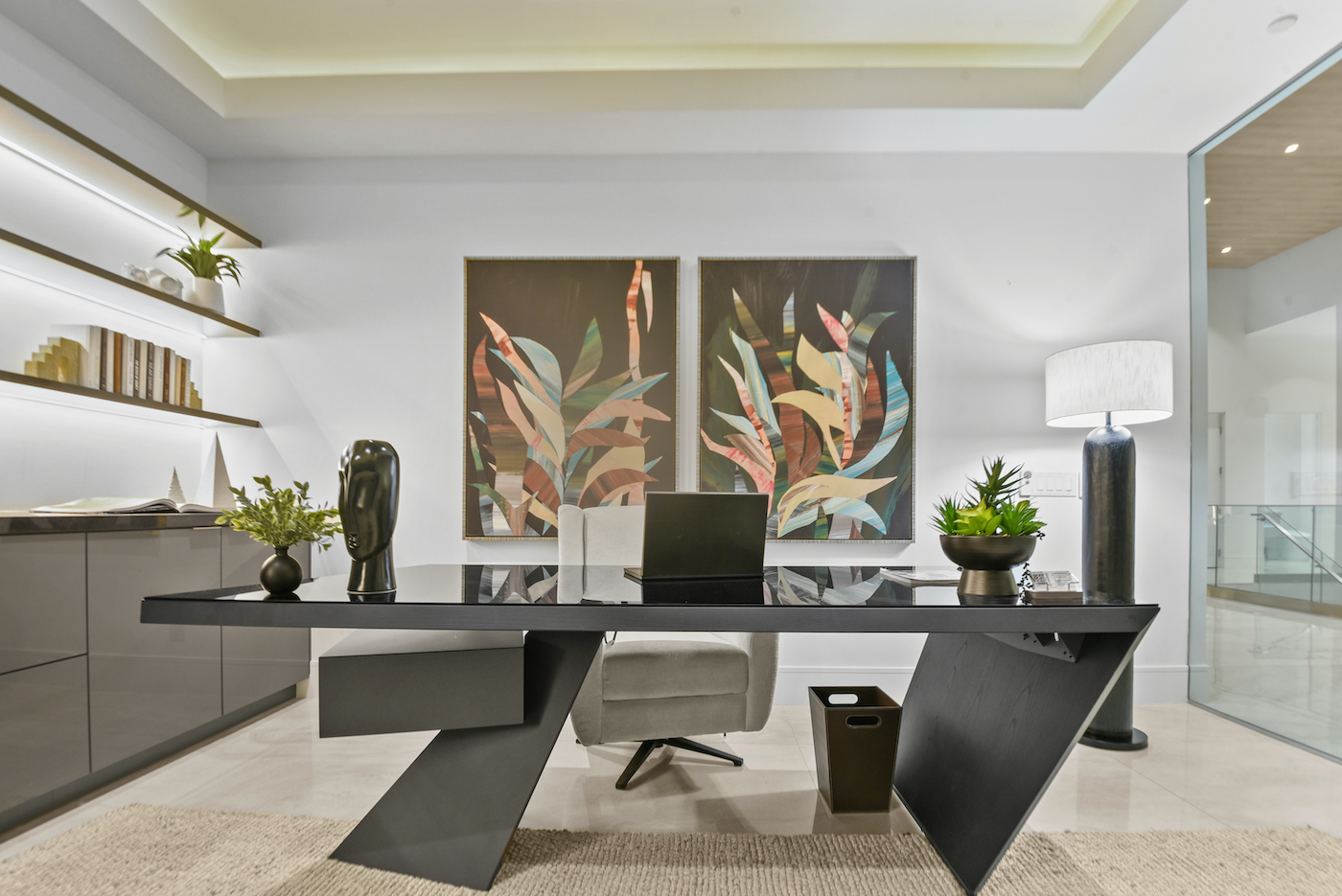

Why the most valuable details of a luxury home aren’t always the first things buyers see—and how strategic staging changes the experience.
Your home may have extraordinary features. That doesn’t mean buyers will notice them.
A dramatic ceiling height. Expansive views. Beautiful architectural details. Exceptional finishes. These are the qualities that help justify a luxury property’s asking price.
But here’s what many sellers don’t realize: buyers don’t experience a home as a checklist of its features.
Their attention is selective. Their impressions form quickly. And the way a room is presented can influence which details they notice, how spacious it feels, and what they remember long after leaving.
A spectacular view can compete with poorly positioned furniture. A generous living room can feel surprisingly awkward when its proportions aren’t properly defined. An architectural feature worth emphasizing can disappear into a photograph filled with visual distractions.
None of these problems requires changing the home itself.
They require understanding how people perceive space.
This is where the science of neuroaesthetics meets the art of professional home staging.
Neuroaesthetics explores how the brain responds to visual experiences, including beauty, composition, and the environments around us. Combined with research into buyer behavior and visual attention, it offers fascinating insight into why certain spaces create an immediate connection while others struggle to communicate their potential.
For Realtors and luxury homeowners, the implications are significant.
Because preparing a property for sale isn’t simply about making it beautiful.
It’s about making sure buyers recognize what makes it valuable.
The Science of a First Impression
Think about how buyers search for homes today.
They scroll through listings, comparing properties in seconds. Before reading the agent’s description, they’re already responding to the photographs.
Research from Old Dominion University provides insight into just how important those images are.
In a 2012 study published in the Journal of Real Estate Research, researchers used eye-tracking technology to observe how prospective buyers viewed online real estate listings.
In the study, approximately 95% of participants viewed the first exterior photograph, and 41.5% never looked at the agent remarks.
Consider what that means for a luxury listing.
A Realtor may carefully communicate the property’s architectural significance, custom finishes, and exceptional features. But if the photographs fail to communicate those qualities visually, some buyers may never engage with the written explanation.
This is why staging and photography should be considered part of the property’s marketing strategy, not simply finishing touches before it goes live.
The first impression isn’t made at the front door anymore. It’s made on a screen.
| Listing element | Viewed first | Viewed second | Viewed third | Not viewed |
|---|---|---|---|---|
| Exterior photo | 95.1% | 2.4% | 2.4% | 0.0% |
| Property facts (beds, baths, sq ft) | 2.4% | 75.6% | 7.3% | 14.6% |
| Agent remarks | 2.4% | 7.3% | 48.8% | 41.5% |
Why a Beautiful Room Isn’t Necessarily a Well-Staged Room
Here’s where the distinction between interior decorating and professional home staging becomes important.
A beautifully decorated room reflects someone’s personal taste. A strategically staged room is designed to help prospective buyers understand the property’s architecture, function, scale, and lifestyle possibilities.
Those objectives aren’t always the same.
Consider a large living room in a luxury Las Vegas home.
Beautiful furnishings alone don’t necessarily communicate the room’s proportions. Oversized pieces can make the space feel smaller. Furniture placed too far apart can make an expansive room feel disconnected. A poorly positioned sectional might interrupt the view that makes the property exceptional.
Our approach begins with a different set of questions.
What is the strongest architectural feature? Where should the eye travel? What furniture scale best communicates the room’s dimensions? How will the space translate through the camera lens?
Sometimes the answer is a more substantial furniture arrangement that gives an oversized room a sense of purpose.
Other times, it’s removing pieces to allow the architecture to breathe.
And occasionally, the most important design decision is what we choose not to place in the room.
Luxury staging isn’t about filling space. It’s about making space meaningful.
The Psychology of Price: Buyers Are Already Evaluating Worth
There’s another fascinating layer to how buyers evaluate properties.
Research published in the Journal of Marketing Research examined what happens when consumers see a price before evaluating a product.
Researchers Uma Karmarkar, Baba Shiv, and Brian Knutson found that presenting price first can change how consumers assess a purchase, placing greater emphasis on monetary worth rather than attractiveness alone.
Although the research wasn’t conducted specifically on homebuyers, its implications are particularly interesting for real estate.
Buyers frequently encounter a property’s asking price alongside its photographs.
Imagine opening a listing priced at $2.5 million.
The home has beautiful architectural details, expansive windows, and generous living spaces. But the furnishings are poorly scaled, the photographs feel flat, and the rooms don’t communicate the level of sophistication expected at that price.
The buyer may struggle to reconcile what they’re seeing with what they’re being asked to pay.
Now imagine that same property presented with furniture proportionate to the architecture, a cohesive visual story, and photography that emphasizes its most compelling features.
The property hasn’t changed.
But the experience of evaluating it has.
This doesn’t mean staging changes a home’s intrinsic market value or guarantees a higher offer. It means presentation can influence whether buyers readily recognize the qualities that support its asking price.
At the luxury level, where expectations rise alongside price, that distinction becomes especially important.

The Three Design Principles That Change How Buyers Experience a Home
Neuroaesthetics and visual-perception research offer useful ways to understand decisions professional stagers make every day.
1. Visual Hierarchy: Giving the Eye Somewhere to Go
Every room has a visual story.
In a well-composed space, the eye moves naturally from one feature to another. A beautiful fireplace becomes the focal point. An expansive window draws attention toward the view. A thoughtful furniture arrangement reinforces the room’s proportions.
But when too many elements compete for attention, the experience becomes less clear.
Oversized artwork, excessive accessories, competing colors, and poorly positioned furnishings can distract from the property itself.
At Utopia Home Staging, we consider how furniture, artwork, lighting, and negative space work together to create a clear visual hierarchy.
The goal isn’t for buyers to admire every decorative element.
It’s for them to notice what makes the home exceptional.
2. Scale and Proportion: Helping Buyers Understand the Space
One of the most common misconceptions about staging is that smaller furniture always makes a room look larger.
In luxury properties, the opposite can be true.
A grand living room furnished with undersized pieces can feel awkward or incomplete. An oversized sectional in a more intimate room can obscure circulation and make the layout appear restrictive.
The relationship between furniture and architecture matters more than furniture size alone.
We evaluate ceiling heights, room dimensions, architectural features, circulation paths, and sightlines before determining how a space should be furnished.
In open-concept homes, this becomes especially important.
Without walls to define every function, furniture must establish where living, dining, entertaining, and transitional spaces begin and end.
Done thoughtfully, the arrangement helps buyers understand the home’s possibilities without having to mentally solve the floor plan themselves.
3. Color and Cohesion: Creating a Memorable Experience
Color influences attention and emotional response, but effective staging isn’t simply a matter of choosing neutral furnishings.
In fact, an entirely neutral room can sometimes feel forgettable.
The more important consideration is cohesion.
A sophisticated palette creates continuity between rooms while allowing architectural finishes, artwork, and distinctive features to stand out.
In some homes, that means warm neutrals and rich natural textures. In others, a carefully introduced cranberry, olive, or deep blue creates the visual interest needed to complement the property’s personality.
We consider existing finishes, architectural style, natural light, and the buyer profile when developing a design direction.
The result should feel intentional and appropriate to the property rather than like a collection of individually attractive pieces.
For luxury buyers, particularly those viewing multiple exceptional homes, that sense of cohesion can help create a more memorable experience.
The Rooms That Deserve the Most Attention
Not every space plays the same role in a buyer’s experience.
The exterior establishes the initial impression. The primary living areas communicate scale and lifestyle. The kitchen, primary suite, and outdoor entertaining areas help buyers imagine their daily routines.
These are among the spaces we prioritize when developing a staging plan.
But there’s an important distinction between prioritizing key rooms and applying the same staging formula to every property.
Consider a luxury home in Summerlin with expansive mountain views.
The primary living area may need a furniture arrangement that preserves those sightlines above all else.
In a Henderson property with an unusual floor plan, defining an additional office or entertaining area may help buyers understand a space they otherwise might overlook.
And in a luxury home with a pool and covered patio, the relationship between the interior living area and the outdoor environment can be particularly important.
Connecting Indoor and Outdoor Living
In Las Vegas, outdoor living is an important part of the lifestyle buyers are looking for. Pools, mountain views, and covered patios can be some of a property’s most compelling features.
When staging a home, we pay particular attention to how the interior living spaces connect with the outdoors.
A thoughtfully staged living room should naturally lead the eye toward a covered patio, outdoor entertaining area, pool, or beautiful view. By creating a visual connection between these spaces, we help buyers perceive the outdoor area as a natural extension of the home’s living environment.
Covered patios are especially valuable because they offer a comfortable transition between indoor and outdoor living while providing shade and an inviting place to relax or entertain.
Furniture placement, sightlines, scale, and cohesive design elements all contribute to how these spaces are experienced. The goal is to create continuity so that buyers can envision the full lifestyle the property offers, rather than seeing the interior and exterior as separate environments.
In the Las Vegas luxury market, where outdoor entertaining and beautiful views are often central to a property’s appeal, this connection can be particularly meaningful.
It’s not simply about staging a room or a patio. It’s about helping buyers envision an entire lifestyle.
The strategy changes because the property changes.
The strongest staging decisions come from understanding what buyers need to see, not simply what furniture will fit.

Why Photography and Staging Must Work Together
A room can look beautiful in person and still photograph poorly.
This is one of the most overlooked considerations in preparing a home for sale.
The camera changes how we experience space. Furniture relationships can appear compressed. Awkward angles can make generous rooms seem smaller. A poorly positioned accessory can compete with an architectural feature.
That’s why we consider photography throughout our staging process, not just after the installation is complete.
Our Final Edit Happens During Installation
One of the processes we take particular pride in at Utopia Home Staging is our hands-on, photography-driven final edit.
During installation, Angelic remotely evaluates the staging through photographs, working directly with the installation team as the rooms come together.
This isn’t simply a final glance at the completed design. It’s an intentional quality-control process that allows us to evaluate how the staging is actually translating through the camera lens while our team is still on-site and adjustments can be made immediately.
What looks beautiful in person doesn’t always translate the same way in photographs.
A chair may need to shift slightly. An accessory might distract from an architectural feature. A sightline may be partially obstructed, or a furniture arrangement may photograph differently than anticipated. Sometimes a detail that seems insignificant in person becomes much more noticeable through the camera.
By reviewing the photography in real time, Angelic can catch things that might otherwise go unnoticed during installation or a traditional walkthrough.
Together with the installation team, she makes refinements to furniture placement, composition, balance, visual flow, and the presentation of each room.
The objective is to ensure that the staging not only looks exceptional in person but also communicates the property’s strongest features beautifully in its listing photographs.
We don’t simply stage a home and hope it photographs beautifully. We evaluate how it photographs and refine the presentation while our team is still there to make it right.
It’s an additional layer of attention, collaboration, and accountability that we believe makes a meaningful difference.
For us, this isn’t an optional finishing touch. It’s built into our installation process and is one of the standards we take particular pride in maintaining.
The Camera Is Part of the Design Process
We evaluate where the strongest camera angles are likely to be, how the furnishings will frame the architecture, and what should remain visible from those perspectives.
Sometimes a small adjustment to a chair, rug, or piece of artwork can make a meaningful difference in the finished photograph.
For Realtors, this coordination matters because the photographs are often the buyer’s first opportunity to experience the property.
Staging and photography shouldn’t be treated as unrelated services.
They’re two parts of the same visual presentation.
The Detail Buyers May Never Mention, but They’ll Remember
Not every aspect of a showing is visual.
Scent, lighting, temperature, cleanliness, and the overall atmosphere can influence how comfortable someone feels inside a property.
An unpleasant odor, for example, may create a negative impression even when the home is otherwise beautifully presented.
This is why preparation matters.
Addressing odors at their source, maintaining comfortable conditions, and ensuring that a property feels fresh and cared for are essential parts of the overall showing experience.
We generally favor a neutral environment rather than relying on strong fragrances to create an impression.
The objective is to allow buyers to experience the home without unnecessary distractions.
Because the more naturally comfortable a property feels, the easier it becomes to imagine living there.
What Buyers Remember After the Showing
Think about the last exceptional home you toured.
Chances are, you remember how the spaces felt.
Perhaps it was the dramatic ceiling height, the way the living room opened toward the outdoors, or the natural light that filled the primary suite.
You probably don’t remember the exact number of accessories on the coffee table.
And that’s precisely the point.
Our goal isn’t for buyers to leave talking about our furniture.
It’s for them to remember the home.
The architectural details. The beautiful proportions. The entertaining possibilities. The sense of arrival. The lifestyle they can imagine enjoying.
Furniture and styling are tools we use to communicate those qualities.
When the presentation works, the property becomes the focus.
And that’s the impression we want buyers to carry with them long after the showing ends.
The Real Value of Strategic Home Staging
For Realtors and homeowners, staging is often evaluated as a line item in the marketing budget.
But that perspective overlooks what professional staging is actually being asked to accomplish.
It’s not simply furnishing an empty property.
It’s interpreting architecture, solving spatial challenges, identifying selling features, anticipating buyer questions, and creating a cohesive presentation that works both in photographs and in person.
It’s knowing when a room needs more furniture, when it needs less, and when a different arrangement can completely change how buyers understand the space.
It’s also having the appropriate inventory, experience, and design judgment to execute those decisions consistently across properties with very different architectural styles, price points, and buyer expectations.
The research helps explain why these details matter.
Our experience helps us determine how to apply them.
Because while staging cannot replace thoughtful pricing, effective marketing, or the fundamentals of a desirable property, it can help buyers recognize the value those fundamentals represent.
The best staging doesn’t ask buyers to appreciate the design. It helps them appreciate the home.
And in a competitive luxury real estate market, making that connection is an important part of presenting a property at its best.
Presenting Your Property With Purpose
Every home has qualities that make it special. Our work is to identify those qualities and bring them forward through thoughtful design, appropriate scale, and a clear understanding of how buyers experience space.
At Utopia Home Staging, we work alongside Las Vegas Valley Realtors and homeowners to create presentations that reflect the character, architecture, and market position of each property.
Preparing a home for sale?
Contact Utopia Home Staging for a complimentary staging estimate.
UtopiaHomeStaging.com | (702) 848-3750
Research References
Seiler, M. J., Madhavan, P., & Liechty, M. (2012). Toward an Understanding of Real Estate Homebuyer Internet Search Behavior: An Application of Ocular Tracking Technology. Journal of Real Estate Research, 34(2), 211–242.
Karmarkar, U. R., Shiv, B., & Knutson, B. (2015). Cost Conscious? The Neural and Behavioral Impact of Price Primacy on Decision Making. Journal of Marketing Research, 52(4), 467–481. https://doi.org/10.1509/jmr.13.0488