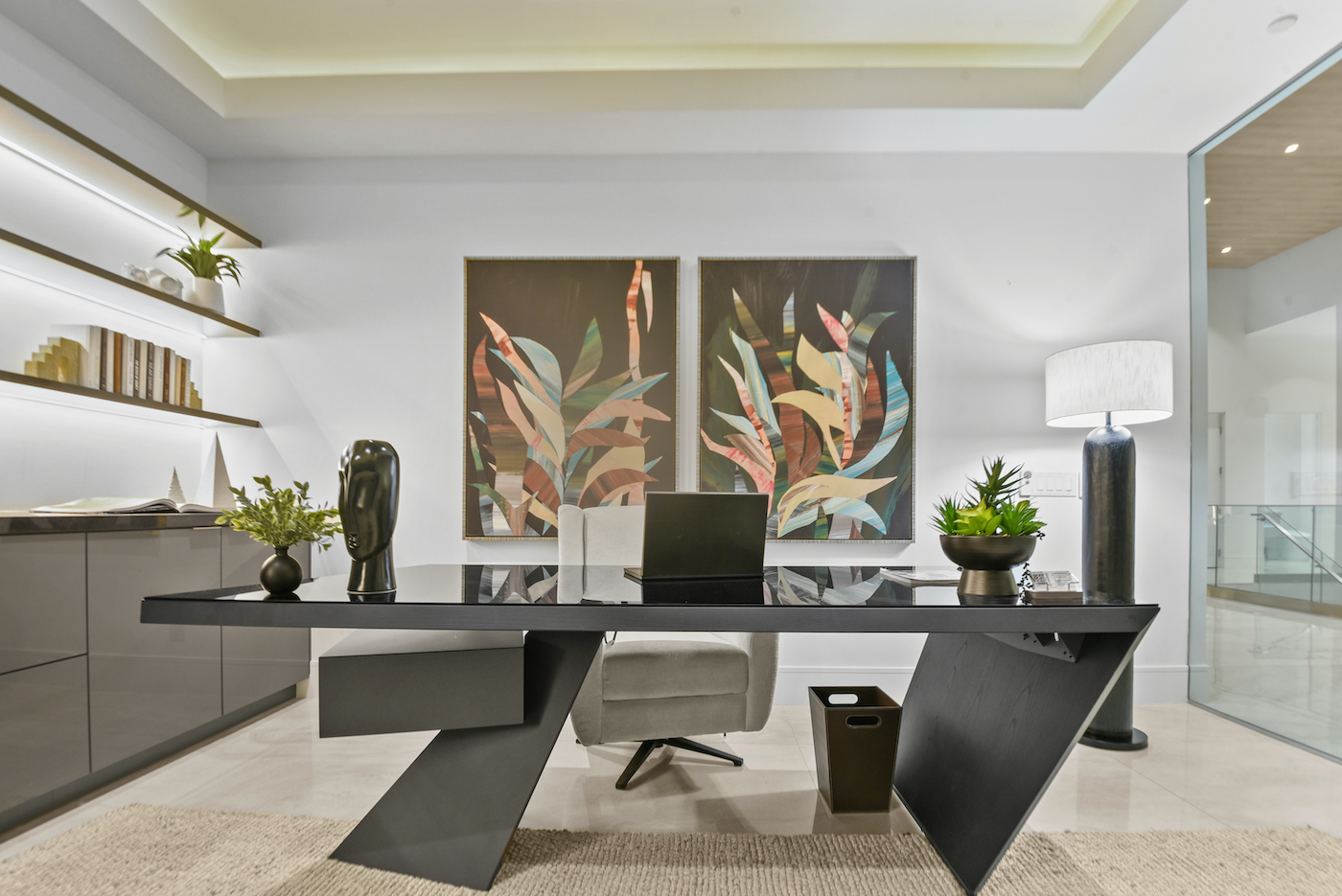

Las Vegas has never been a market that rewards doing things the conventional way.
That is increasingly true of home staging.
The Las Vegas real estate market brings together an unusual combination of conditions: dramatic differences in price point and architecture, a large inventory of vacant properties, year-round listing activity, extreme climate considerations, resort-influenced expectations, and a steady flow of buyers relocating from other major metropolitan markets.
The result is a market where staging has had to evolve quickly.
For professional stagers, Las Vegas has become something of a laboratory — a place where ideas about buyer psychology, photography, scale, lifestyle presentation, and property marketing are tested across an extraordinarily diverse range of homes.
For sellers and listing agents, that evolution matters. Because staging today is becoming much less about simply furnishing an empty house and much more about understanding how buyers experience one.
Las Vegas Real Estate Staging Has an Unusual Testing Ground
Think about the range of properties that can exist within a relatively small geographic area of Las Vegas.
A staging company might work on a modest investment property one week, a contemporary Summerlin residence the next, followed by a Strip high-rise, a sprawling Henderson home, or an estate valued well into eight figures.
At Utopia Home Staging, we stage approximately 100 homes year over year, across an extraordinary range of price points, architectural styles, neighborhoods, and buyer profiles.
That volume and variety create something valuable:
Feedback.
Every property becomes another opportunity to understand how buyers respond to scale, furniture placement, color, photography, architecture, and lifestyle presentation.
When something works particularly well, we want to understand why.
When a property takes longer than expected, we want to understand that too.
Over time, staging stops being a collection of design opinions and becomes a continually evolving marketing discipline.
One recent example was City View Ridge, an $8.1 million luxury property staged by Utopia that went under contract in just three days.
The important question for us isn’t simply, “Wasn’t that a great result?”
It is:
What helped create it?
Was it how buyers understood the scale of the rooms? The relationship between indoor and outdoor spaces? The photography? The emotional experience of walking through the property? The way previously difficult spaces were given purpose?
Those are the questions that move staging forward.
Television Changed What Buyers Expect
Las Vegas has also occupied an unusual place in the evolution of real estate television.
HGTV productions including Flip the Strip, Ugliest House in America, Sin City Rehab, and the upcoming The House My Talent Bought have brought — or will bring — Las Vegas homes and design to a national audience.
Utopia Home Staging has worked on all four productions, including The House My Talent Bought, which has not yet aired.
That experience has given our team a firsthand look at how homes are composed not only for someone standing in a room, but also for a camera.
And that distinction has become increasingly relevant to everyday real estate.
The National Association of REALTORS®’ 2025 Profile of Home Staging found that 48% of respondents said buyers expected homes to look as though they had been staged for television, while 58% reported that buyers were disappointed when homes they toured did not live up to what they had seen on television.
Television didn’t simply entertain buyers.
It helped train their eyes.
Today’s buyer has spent years seeing professionally styled interiors on television, social media, luxury real estate websites, and architectural publications before ever walking into your listing.
That has raised the standard for presentation.
And because the first showing now usually happens through a screen, staging has to work in two environments at once.
It has to stop the buyer online — and then reinforce that expectation when they arrive in person.
The goal isn’t to create an image that makes a property look like something it isn’t. The strongest presentation builds trust because the home buyers became excited about online is the home they actually experience when they walk through the door.

From Television Experience Back to Real Estate
Our experience working on television also taught us something important.
Television staging and real estate staging are not the same thing.
A television production is designed primarily for the camera. Real estate staging has a different responsibility:
The buyer ultimately has to walk through the space.
Furniture scale has to make sense.
Traffic patterns have to work.
Sightlines matter from multiple directions.
Rooms need an understandable purpose.
Outdoor areas need to connect naturally to the interior.
And the emotional promise made by the listing photography needs to continue throughout the physical showing.
The most useful lesson from television wasn’t how to make a house look like television.
It was learning to think more deliberately about how a property is seen.
Las Vegas Is Connected to a Larger Staging Conversation
Innovation doesn’t happen in isolation.
The staging industry has increasingly developed collaborative networks through which experienced firms exchange ideas, market observations, performance information, and operating practices.
Utopia Home Staging is a founding member of The Staging Collective, a national network of established staging professionals working in markets across the country.
That creates an exchange of information in both directions.
What are luxury buyers responding to in Los Angeles?
What is changing in New York?
How are other firms approaching difficult architecture, large-scale inventory, logistics, or changing buyer demographics?
And what can Las Vegas teach those markets?
Ideas developed elsewhere can be tested here, while the volume and diversity of Las Vegas real estate give us insights we can contribute to the broader conversation.
For the seller, that matters because the strategy being brought into a Summerlin or Henderson property doesn’t have to exist inside a Las Vegas bubble.
It can be informed by what sophisticated buyers are seeing across the country.
For more about how the profession itself has changed, read The Evolution of Home Staging: From Empty to Experiential.
The Next Evolution of Staging Is Data
Perhaps the most important change happening in professional staging has very little to do with furniture.
It is measurement.
For years, the staging industry relied heavily on anecdotes:
This house sold immediately.
That seller received multiple offers.
Buyers loved this room.
Those stories can be useful, but they aren’t enough.
At Utopia, we increasingly compare our staging outcomes against broader Las Vegas market performance to understand whether patterns exist across our portfolio.
Our internal analysis has shown Utopia-staged properties selling approximately 33 days faster than broader Las Vegas market benchmarks and receiving offers approximately 4% higher than comparable market results.
These are Utopia’s internal portfolio observations, not a promise that staging will produce the same outcome for every property. Price, condition, location, interest rates, inventory, and marketing strategy all affect a sale.
But that is exactly why tracking matters.
The purpose isn’t to manufacture a statistic.
It is to learn.
If certain approaches consistently perform better, we want to know.
If results differ by price tier, architecture, or buyer profile, we want to understand that too.
And if the market changes, our staging strategy should be capable of changing with it.
Design creates the experience. Data helps refine it.
Luxury Listings Make the Stakes Even Higher
The value of that thinking becomes especially clear as price points rise.
A luxury property isn’t simply a larger version of an average home.
Rooms become larger and harder to scale correctly. Architecture becomes more individual. Outdoor environments carry greater importance. Secondary spaces — lounges, wine rooms, offices, casitas, game rooms, and oversized transition areas — can become major selling features or confusing liabilities depending on how they are presented.
At the same time, the financial consequences of additional days on market become greater.
That changes the staging conversation.
The question is no longer:
“How do we make this room look nice?”
It becomes:
“What does the buyer need to understand about this property?”
Sometimes staging needs to demonstrate scale.
Sometimes it needs to establish purpose.
Sometimes it needs to redirect attention toward architecture.
And sometimes its most important job is removing the objections a buyer might otherwise create when confronted with an empty or unusually configured room.
That is a fundamentally different way of thinking about staging.
Innovation Doesn’t Mean Chasing Trends
Being innovative does not mean filling houses with whatever furniture style happens to be trending on social media.
In fact, sophisticated staging often moves in the opposite direction.
The objective is restraint.
We generally begin with a neutral foundation and introduce controlled color, texture, art, and accessories where they can direct the eye, establish mood, or reinforce an architectural feature.
The property should remain the hero.
That principle becomes particularly important in Las Vegas, where architectural styles can shift dramatically from one neighborhood — or even one street — to another.
A contemporary home overlooking the Strip should not necessarily be staged like a Spanish-influenced home in Red Rock Country Club.
A golf-course property may need a different lifestyle story than a high-rise residence.
Innovation means becoming more responsive to the property, not more attached to a staging formula.
What This Means for Las Vegas Sellers and Realtors
If Las Vegas is becoming a testing ground for more sophisticated staging, sellers and listing agents should expect more from the staging conversation.
Ask what the strategy is.
Who is the likely buyer?
What features of the property need to be emphasized?
What objections need to be resolved?
How will the rooms photograph?
What will buyers see when they enter?
How will their eye move through the home?
Does the staging company track its results?
And perhaps most importantly:
Why is the home being staged this way?
A professional stager should be able to answer that question.
Because at its highest level, staging isn’t decorating.
It is property marketing expressed through space.
And Las Vegas — with its extraordinary homes, demanding buyers, national exposure, and constantly changing real estate landscape — is proving to be an unusually good place to push that discipline forward.

Las Vegas Home Staging: Frequently Asked Questions
Why is Las Vegas becoming an important market for staging innovation?
Las Vegas combines year-round real estate activity, significant relocation, a wide range of home values and architectural styles, substantial vacant inventory, and buyers accustomed to sophisticated visual marketing. That gives professional staging companies an unusually diverse environment in which to test and refine presentation strategies.
How has television influenced home staging?
Television and digital media have significantly raised buyer expectations. According to the National Association of REALTORS®’ 2025 Profile of Home Staging, 48% of respondents said buyers expected homes to look as though they had been staged for television, while 58% said buyers were disappointed when actual homes didn’t compare favorably with what they had seen on TV.
For professional stagers, that makes understanding photography, sightlines, scale, and visual composition increasingly important.
How does HGTV experience translate to real estate staging?
Television production teaches an intense awareness of what the camera sees — composition, scale, sightlines, and visual distractions.
Real estate staging takes those principles further because the property must work both in photographs and in person. The goal is for the physical showing to reinforce the expectation created online rather than contradict it.
Utopia Home Staging has worked on four HGTV productions in Las Vegas, including one that has not yet aired.
What is The Staging Collective?
The Staging Collective is a national network of established staging professionals. Utopia Home Staging is a founding member. The collaboration allows participating companies to exchange ideas, market observations, operating practices, and insights from different real estate markets around the country.
For Utopia, it provides another source of information we can bring back to our work in Las Vegas while contributing what we’re learning from this market.
Why does staging data matter?
Tracking performance helps a staging company identify patterns rather than relying exclusively on individual success stories.
Utopia analyzes its staged properties against broader Las Vegas market benchmarks to study days on market, pricing outcomes, and performance by price tier. Those findings can then help inform future staging decisions.
Should every Las Vegas home be staged the same way?
No. Effective staging should respond to the property’s architecture, price point, likely buyer, neighborhood, strongest selling features, and potential objections.
A Strip high-rise, a Summerlin contemporary, a Spanish-influenced residence, and a golf-course estate may require completely different staging strategies.
Is staging more important in a buyer’s market?
Presentation generally becomes more consequential when buyers have more choices.
Staging cannot compensate for incorrect pricing or significant property deficiencies, but it can help buyers understand a home’s scale, function, lifestyle, and strongest features — while helping a listing compete for attention both online and in person.
Strategic Home Staging in Las Vegas
The next generation of home staging isn’t about adding more furniture.
It’s about understanding more about the buyer.
At Utopia Home Staging, we combine design, buyer psychology, Las Vegas market experience, national collaboration, and ongoing performance analysis to create a staging strategy specifically for the property being sold.
Call Scott at 702-848-3750 or request a complimentary estimate online to discuss how strategic staging can position your Las Vegas property for its strongest presentation.
Angelic Fergusonis the Founder and Lead Designer of Utopia Home Staging, a two-time Best of Las Vegas winner and HGTV-featured staging company serving the greater Las Vegas market.